Sections
You are here: Home Publications Special Reports

Special Reports

wind.jpg

Special Report Renewable Energy Sources and Climate Change Mitigation

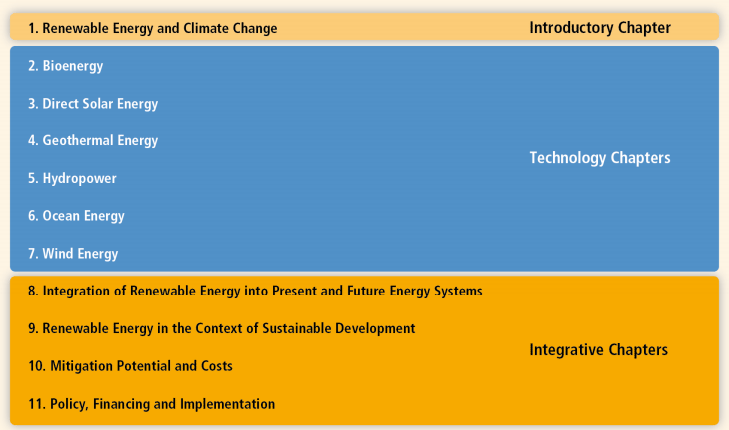
At the 25th Session of the IPCC, held in Mauritius from 26-28 April, 2006 it was decided to carry out a scoping meeting for a possible IPCC Special Report on the contribution of renewable energy sources to the mitigation of climate change. At the 28th IPCC Plenary in Budapest, 9-10 April, 2008 the Scoping Paper for the Special Report was accepted with modifications and the Plenary approved the development of a Special Report on Renewable Energy Sources and Climate Change Mitigation (SRREN) by WG III. The goal of the SRREN is to assess existing literature on the future potential of renewable energy for the mitigation of climate change. It covers the six most important renewable energy technologies, as well as their integration into present and future energy systems, the environmental and social consequences associated with them, cost considerations and strategies to overcome technical as well as non-technical obstacles to their application and diffusion. Subsequent to the 28th IPCC Plenary, a full nominations process was carried out in accordance with IPCC Principles and Procedures, SRREN Coordinating Lead Authors and Lead Authors were selected, and the first SRREN Lead Author Meetings were held. Approval of the SRREN by the IPCC Plenary is expected in February, 2011, and its final publication in late spring, 2011.


Special Report on Carbon Dioxide Capture and Storage, 2005

Carbon dioxide (CO2) capture and storage (CCS) is a process consisting of the separation of CO2 from industrial and energy-related sources, transport to a storage location and long-term isolation from the atmosphere. This report considers CCS as an option in the portfolio of mitigation actions for stabilization of atmospheric greenhouse gas concentrations.

Special Report on Safeguarding the Ozone Layer and the Global Climate System: Issues Related to Hydrofluorocarbons and Perfluorocarbons, 2005

The report contains a brief summary of relevant findings regarding the relation of ozone layer depletion and global warming. Furthermore, it has information on options to replace ozone-depleting substances that simultaneously contribute to the objective of the Climate Convention and the Montreal Protocol, and finally there is publicly available information on currently installed and planned global production capacities and a summary of available demand and emission projections of HFCs and PFCs.

Special Report on Emissions Scenarios, 2000

The long-term nature and uncertainty of climate change and its driving forces require scenarios that extend to the end of the 21st century. This Report describes the IPCC scenarios and how they were developed. The SRES scenarios cover a wide range of the main driving forces of future emissions, from demographic to technological and economic developments.

Special Report on Technology Transfer, 2000

The report addresses the technology transfer problem in the context of climate change while emphasizing the sustainable development perspective. A number of social, economic, political, legal, and technological factors influence the flow and quality of technology transfer.

Special Report on Land Use, Land Use Change, and Forestry, 2000

This is a report examining the scientific and technical state of understanding for carbon sequestration strategies related to land use, land-use change, and forestry activities and relevant Articles of the Kyoto Protocol. It discusses the global carbon cycle and how different land use and forestry activities currently affect standing carbon stocks and emissions of greenhouse gases. It also looks forward and examines future carbon uptake and emissions that may result from employing varying definitional scenarios and carbon accounting strategies, linked to the Kyoto Protocol, within the forestry and land-use sectors.

Special Report on Aviation, 1999

The report considers all the gases and particles emitted by aircraft into the upper atmosphere and the role that they play in modifying the chemical properties of the atmosphere and initiating the formation of condensation trails (contrails) and cirrus clouds. The report then considers (a) how the radiative properties of the atmosphere can be modified as a result, possibly leading to climate change, and (b) how the ozone layer could be modified, leading to changes in ultraviolet radiation reaching the Earth’s surface.

Document Actions